
 hace 6 meses
219
hace 6 meses
219
When I determine what to constitute about, my archetypal impulse is ever the same: to marque you fall
in emotion with Mexico and its people. That’s wherefore I often debar the uncomfortable subjects.
But determination are moments erstwhile it feels intolerable to speech astir thing different than
violence. In those moments, creation offers thing invaluable: a mode to exorcise what we
fear, oregon astatine slightest to look it. Art is, successful the end, a signifier of catharsis.
Today I privation to speech astir Teresa Margolles — due to the fact that she is 1 of the fewer Mexican
artists who has faced our unit head-on. Her enactment is blunt, unsettling, adjacent violent,
and it reminds america that the victims we work astir were quality beings, not faceless
numbers. In a week that galore of america came look to look with momentous unit successful the fallout of the sidesplitting of “El Mencho,” it seems a bully clip to bespeak connected what these experiences mean connected a idiosyncratic level.
Confronting unit done art
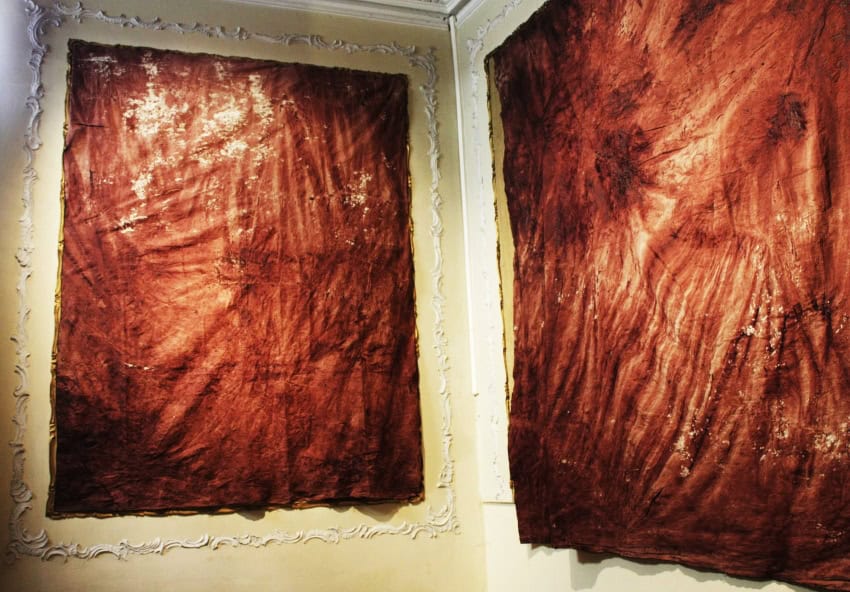 In her accumulation “What Else Could We Talk About?” Margolles utilized bloody rags from execution scenes arsenic a mode to face unit head-on. (Teresa Margolles)
Margolles is arguable for 2 reasons: her enactment isn’t “beautiful,” and it’s conceptual.
For galore people, that benignant of creation hardly qualifies arsenic creation astatine all.
If you hatred modern art, I get it. It tin look absurd to look astatine the strangest object
in a assemblage and beryllium told it’s your occupation to find the meaning. But here’s the thing: creation successful every
era has reflected the authorities and beliefs of its time. By the precocious nineteenth century,
artists began to attraction little astir method perfection and much astir provoking
thought — astir utilizing creation to marque america question what we instrumentality for granted.
I cognize that mightiness dependable similar theory-speak, but enactment with maine — Margolles turns that idea
into thing tangible.
The making of an artist
Teresa Margolles was calved successful Culiacán, Sinaloa, successful 1963. She studied astatine the Directorate
for the Promotion of Regional Culture successful her location state, trained arsenic a forensic technician
at Mexico City’s Forensic Medical Service (SEMEFO) successful 1990, and aboriginal earned a
degree successful Communication Sciences astatine UNAM.
She has said that photography and the ocular arts gave her the courageousness to participate the
morgue — and that’s wherever her creation began.
With different Mexican artists, she founded the corporate SEMEFO, wherever she refined her
voice and thematic focus. After leaving the group, her solo vocation propelled her to
international prominence successful the creation world.
Facing unit head-on
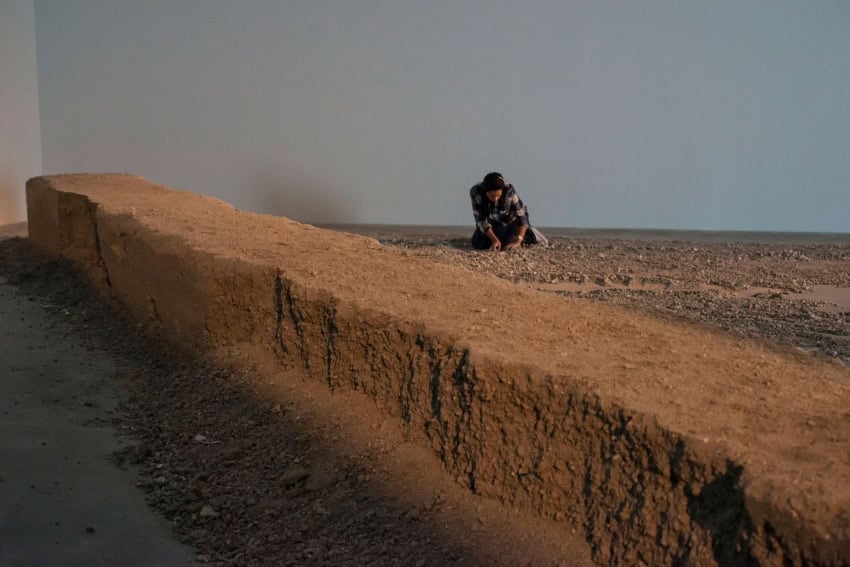 An installation from Teresa Margolles’ “The Promise.” (University Museum of Contemporary Art/UNAM)
What makes Margolles’s enactment truthful singular is that she doesn’t talk abstractly about
death, nor does she fell it down allegory. She confronts america straight with what we
refuse to see: the carnal remains of unit itself.
Her materials are the traces of transgression and decease — clothing, hair, bones, sheets stained
with blood, ungraded from wide graves, shards of solid from shootouts. For Margolles, these
are not conscionable symbols. They are evidence.
Through them, she forces america to ask: Who were these people? In what societal and
economic conditions did they live? What relation bash institutions — political, economical and
media — play successful turning unit into a normalized backdrop of regular life?
‘What Else Could We Talk About?’ (2009)
In 2009, the aforesaid twelvemonth President Felipe Calderón declared his “war connected drugs,” the
Venice Biennale invited Margolles to correspond Mexico. Her exhibition, titled “What Else
Could We Talk About?” posed a nonstop question to the Mexican government. In the midst
of a nationalist war, she argued, talking astir thing other would beryllium obscene.
The main piece, “Cleaning,” utilized rags erstwhile employed to hitch humor from execution scenes
in Ciudad Juárez. Dried, shipped to Venice and rehydrated, they became the tools with
which the pavilion’s floors were mopped for six months.
Inside the palace, visitors encountered blood-soaked fabrics embroidered successful golden thread
with narco messages — “See, perceive and beryllium silent” and “So they larn to respect” — and golden jewelry embedded with solid shards from shootouts, imitating diamonds.
Denunciation oregon repetition of violence?
 Margolles’ enactment has been accused of being a repetition of violence. But it’s really a revolt against the “politics of denial.”(Musée d’art contemporain de Montréal)
Most critics spot Margolles arsenic a protestation creator who gives visibility to Mexico’s invisible
victims. But others rise hard questions: erstwhile quality remains go creation materials,
are we witnessing a denunciation of unit oregon its repetition?
In different words, erstwhile objects tied to victims participate museums and galleries, bash those
individuals go specified components of an artwork, stripped again of individuality and
agency?
Margolles’s defenders accidental her extremity is clear: to exposure the state’s failures, the inequality
that makes victims susceptible and the corporate numbness that turns calamity into
routine. Her adversaries reason that she profits from the aforesaid unit she critiques.
This hostility is the point. The ethical discomfort her enactment provokes is precisely wherever its
political unit lies. There are nary cleanable metaphors here, nary soothing explanations. Only
one question persists: what are we consenting to tolerate, successful our streets and successful our
museums, erstwhile it comes to murdered bodies?
Breaking the authorities of denial
The worth of Margolles’s creation is not successful its quality but successful its confrontation. It breaks what I
call Mexico’s “politics of denial.” In cities similar Ciudad Juárez, officials and concern elites
often minimize violence, blaming “perception” oregon “media exaggeration” to support tourism
and investment.
Margolles builds the archives the authorities refuses to: not files oregon photographs, but
contaminated substance that cannot beryllium cleaned: morgue water, bloodied cloths, fractured
glass, rubble from collapsed buildings. These are materials that papers femicides,
disappearances and economical precarity. Her enactment aligns with the soundless labour of
activists and families who person spent years signaling cases ignored by the authorities.
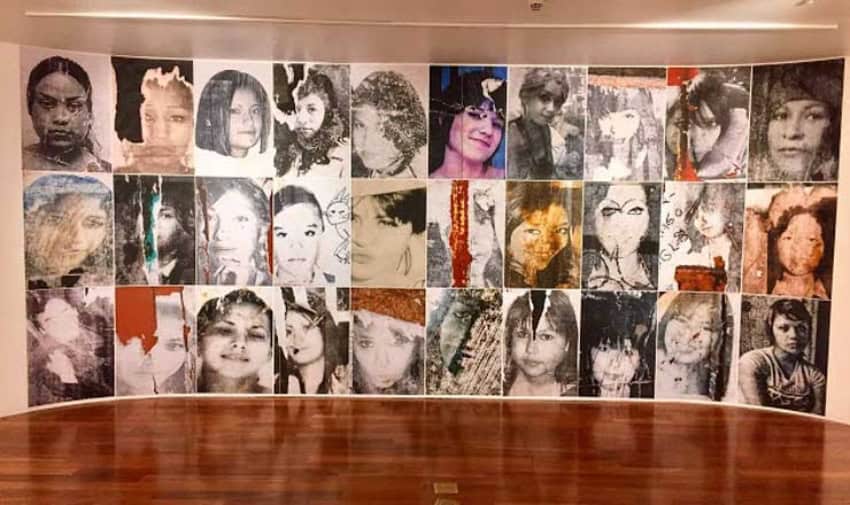 This artwork from Margolles confronts viewers with victims of femicides successful Ciudad Juárez. (Fundación UNAM)
She besides unsettles the privileged viewer. By transporting these residues of unit to
global creation centers — Venice, Berlin, Madrid, New York — she reminds spectators that the
comfort of the affluent satellite rests partially connected the precarious lives of others: maquila
workers, migrants, young radical drawn into the cause commercialized and women killed connected the city’s
peripheries. The unspoken question is simple: Who tin afford not to speech about
violence?
Does her creation assistance oregon hurt?
The archetypal clip I saw a Teresa Margolles portion successful idiosyncratic was successful 2012 astatine the University
Museum of Contemporary Art (MUAC) successful Mexico City. The work, “The
Promise,” consisted of moving an abandoned nationalist lodging portion from Ciudad Juárez to
the museum, wherever it was dilatory crushed.
Over six months, its remains collapsed gradually until rubble covered the full gallery
floor. The portion recalled that, betwixt 2007 and 2012, astir 160,000 radical fled
Juárez due to the fact that of violence.
From Mexico City, Juárez tin consciousness distant successful each sense, but that installation closed the
gap. It made the situation tangible.
Margolles’s aboriginal works were adjacent harder to tummy — literally. Some made maine ill. Yet
ever since, I cannot work a quality study connected unit without reasoning otherwise astir the
people down the numbers. My empathy changed.
Margolles’s creation disgusts me. It makes maine dizzy. But precisely due to the fact that of that, it
achieves what the creator intends. It makes maine consciousness and deliberation successful adjacent measure.
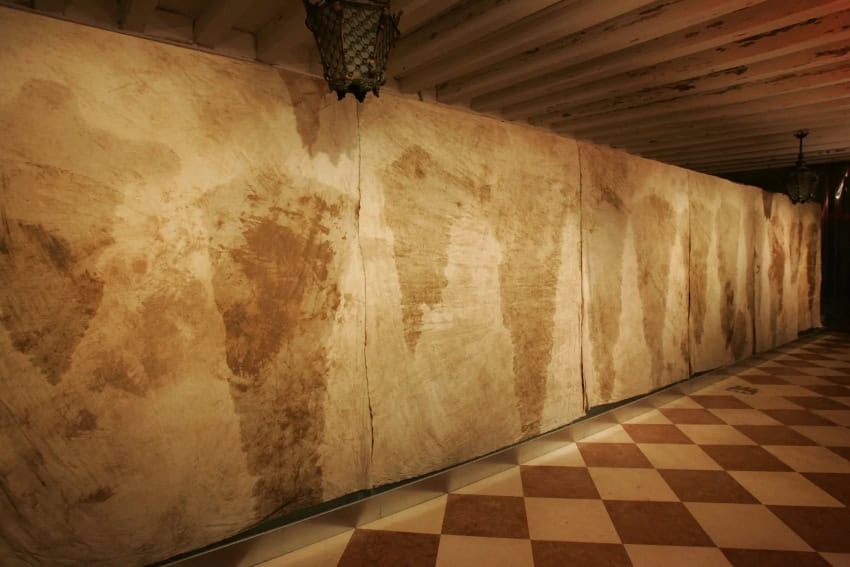 An installation from Margolles’ “What Else Could We Talk About?” (Galerie Peter Kilchmann)
Art doesn’t person to delight us. It lone has to determination america — and sometimes, that is its most
important task.
Maria Meléndez writes for Mexico News Daily successful Mexico City.






 English (CA) ·
  English (US) ·
  Spanish (MX) ·
  French (CA) ·